
Can't feel it, but your floor is shifting
A wood floor is never finished moving. Wood behaves a little like a sponge. It pulls moisture out of the air when the air is damp, and gives it back when the air is dry. It does this quietly, season after season, for as long as the floor exists. It swells slightly in the summer and shrinks slightly in the winter, every year, forever. Most of what homeowners call a defect is simply that movement doing exactly what it is supposed to do, in a house that was not set up for it. Once you understand the movement, you can predict your floor instead of worrying about it.
Boards get wider and narrower, not longer and shorter
Here is the single most useful thing to know: a board barely changes in length, but it does change in width. That is why you see small gaps open up between the boards, running along their long edges, and almost never at the ends. In a dry Ontario winter, thin lines appear between boards. By July, they have closed up again. That is not a failure. That is a floor breathing.
Wider boards move more
The amount of movement is tied to how wide the board is. A wide plank, say seven inches, will move about twice as much as a narrow strip of three and a half inches, sitting in the same room, in the same week. You have not done anything wrong. You bought twice the movement in each board. This is why those beautiful wide plank floors show noticeable gaps in February, and why an old narrow strip floor barely does. If you love the wide plank look, that is a completely reasonable choice. Just know what comes with it, and control the air in your house.
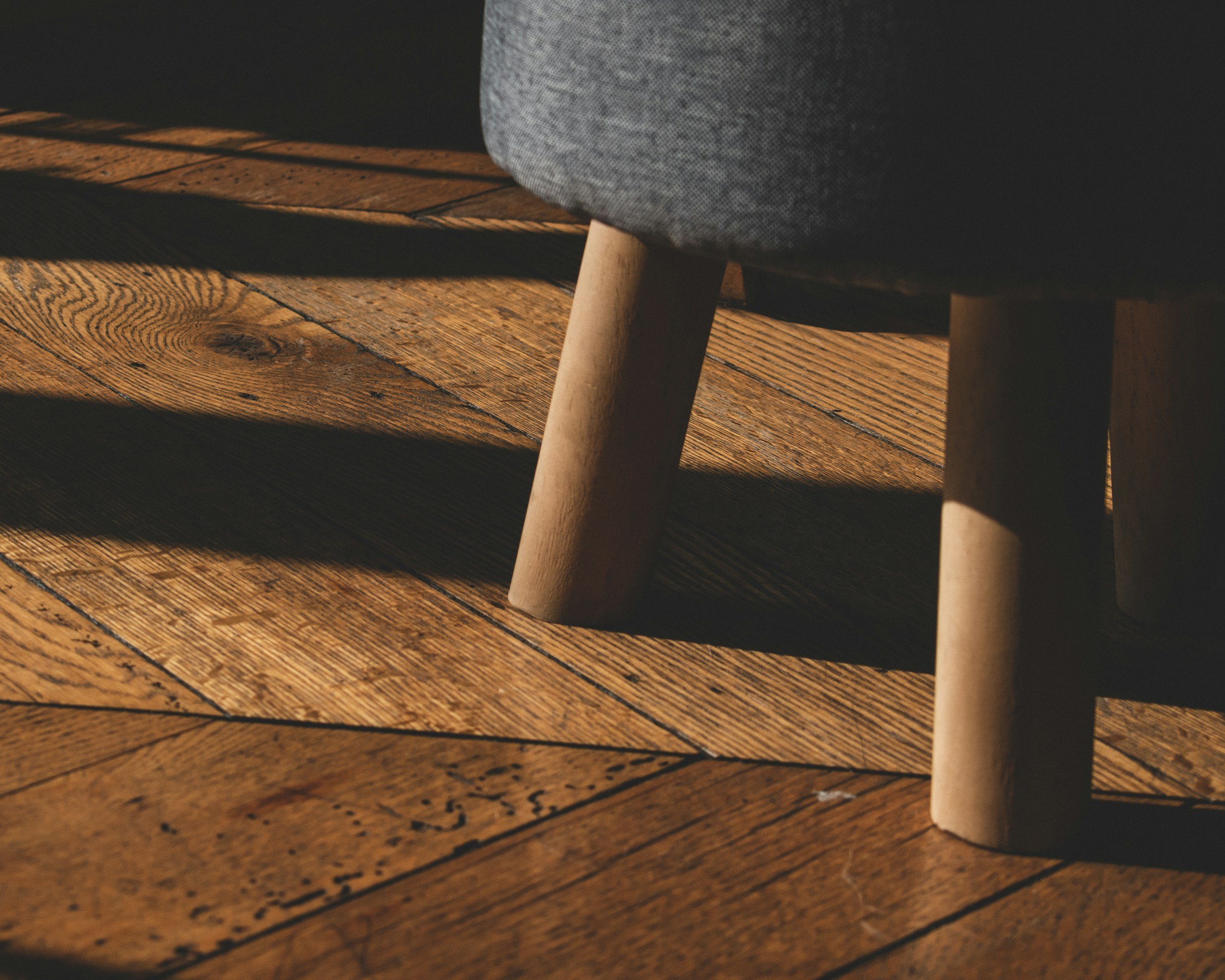
Stool resting on warm hardwood.
Some woods move more than others
Not every species behaves the same. Hickory and maple move more than oak. Walnut moves less. So a wide plank hickory floor in a house that runs very dry all winter is a floor that will move a lot. We would still install it if that is what you want. We would just have a conversation about a humidifier first.
The real reason engineered hardwood exists
Engineered hardwood is a layer of real wood on top, bonded to a base built from several thin layers glued in alternating directions. That construction is the whole point. Because the layers pull against each other, none of them can move very much. The wood you walk on is held steady by what is underneath it. Most people assume engineered hardwood is the budget version of solid wood. It is not. It was created to be more stable, which is why it is the right answer for basements, condos, and anywhere the humidity is hard to control. Being less expensive was a side effect.
Want a straight answer for your home?
Every house is different, and the right floor depends on your rooms, your humidity, and how long you plan to stay. If you are choosing a floor, or you are looking at one that is behaving in a way you do not understand, get in touch. We are happy to walk you through it, whether or not you end up hiring us.
